



The Sane and Sober Words of Zohran Mamdani / 34 Ecuadorean Sailors Cleared Of All Charges / Trump’s Nonstop Insider Trading / Say “Artificial Intelligence” and You’re The Enemy / America In Retreat Everywhere
Mamdani’s Sane and Sensible Statement on October 7
New York Times
Charles & Scott: On October 7th, the third anniversary of the Hamas attack that killed more than 1100 Israelis and led to the abduction of 251 others, New York City Mayor Zohran Mamdani issued a compassionate and intelligent statement mourning “the horrific war crimes” of that day. Then he used more words to decry the Israeli government’s “devastating, ongoing genocide in Gaza.”
The space he devoted to each event was appropriate and proportionate–because the Israeli response to the original tragedy has lasted three years longer than the attack by Hamas, and killed tens of thousands more than Hamas did.
This is what the Mayor said:
This day is profoundly painful for so many New Yorkers. It marks three years since the horrific war crimes of October 7. On that day, Hamas killed more than 1,100 Israelis and abducted 251 others. We grieve alongside our many friends and neighbors who still carry that unthinkable loss. The suffering did not begin nor end that day. It instead continued through the Israeli government’s devastating, ongoing genocide in Gaza, in which it has killed more than 74,000 Palestinians—including more than 21,000 children. Even since the so-called ceasefire, more than 1,400 Palestinians have been killed. That suffering has intensified with every Israeli bomb dropped on ambulances waiting outside hospitals, every drone strike targeting a residential building or journalist, and every shipment of food aid turned away at a border crossing. Many New Yorkers are reckoning with this unbearable grief, and we mourn alongside them - all while knowing that our tax dollars fund these war crimes. Three years later, we must refuse to accept a world in which occupation and apartheid continue, where war crimes are met with impunity, and our federal government continues its complicity with every arms shipment. To honor the dead, we must fight for a world in which every person can live with freedom, safety, and dignity.
The New York Times, whose coverage of Mamdani has ranged from skeptical to petty to openly hostile, focused on the anger of a handful of Jewish leaders who accused the Mayor of being insensitive to their pain.
Rabbi Ammiel Hirsch, the president of the New York Board of Rabbis, said Mr. Mamdani’s statement was “morally perverse” and “like sticking a knife into the pain of the Jewish community in New York and in America.”
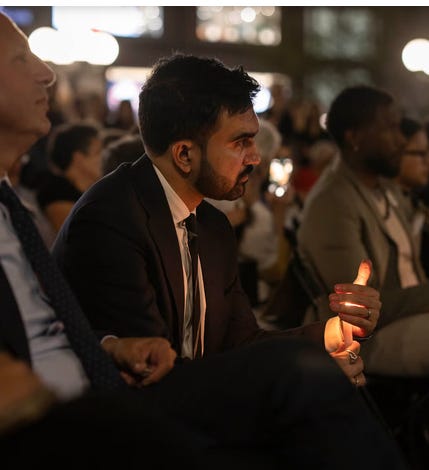
The 112th Mayor of the City of New York
The Times story seemed to endorse the criticism of Jewish leaders by noting “the bulk” of the Mayor’s statement “provided a detailed denunciation of Israel’s military actions in Gaza since the attacks, which Mr. Mamdani described as a ‘devastating, ongoing genocide.’ He did not provide a similarly detailed account of the killings of Israelis and abductions of hostages.”
The implicit attitude of The Times story and the Mayor’s critics is that Jewish lives count, while Palestinian lives count for much less.
Scott and I agree that the attacks on the Mayor’s statement were groundless and unhinged. There is nothing offensive about the Mayor’s approach to any ethical citizen of the world.
The war crimes perpetrated by Hamas and the IDF are grave and deserve condemnation; the perpetrators of these crimes ahold be held to account, but neither the Palestinians nor the Israeli people as a whole are culpable for these war crimes. That was the point of the Mayor’s statement.
34 Sailors Survived a US Attack on their Boats; They Were Just Found Innocent of the Charges the US Leveled at Them
Diario Ahora
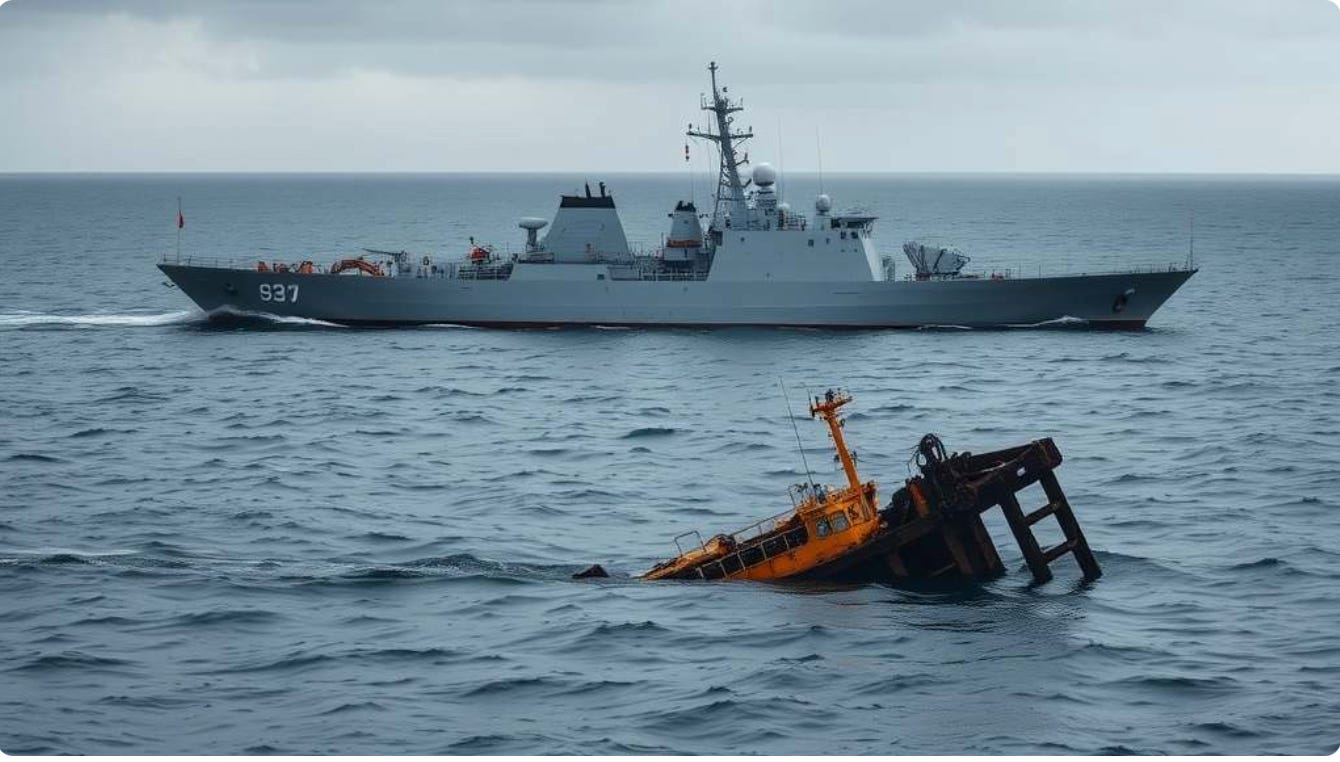
Scott: We now know that a stream of senior officers, including the former commander in chief of Southcom, resigned rather than execute Pete Hegseth’s military operations targeting ostensible narcotics trafficking exercises—which have now killed 234 people in 78 separate attacks. The opposition to the measure was clear enough: these operations have historically been the responsibility of the US Coast Guard, which has an excellent track record in carrying them out; moreover, the intelligence used for the attacks is highly speculative, and—according to DEA officers—rarely has a more than 50% likelihood of being accurate. To execute people based on such assessments is in fact a crime (it’s called, in technical terms, extrajudicial execution). But Hegseth was emphatic: there would be no arrests, no people taken into custody, and no trials. He simply wanted them dead. He assumed, correctly, that dead men would be less capable of embarrassing him. In other words, he specifically authorized extrajudicial killings—and this is of course a crime as well.
In an effort to save its citizens from this predatory conduct of Hegseth’s Pentagon, Ecuador worked out a deal under which survivors of strikes that occurred in or off Ecuadorean waters would be turned over to Ecuador. Ecuadorean prosecutors would be supplied with whatever evidence the US had (and was willing to share) that supported the strikes, so they could be prosecuted.
More than a hundred sailors were simply set loose after prosecutors, reviewing the US evidence and coupling it with their own, concluded there was no material evidence that would support a prosecution. More than eighty were charged, with their trials to occur in three separate groups. This week the first of these trials concluded with a verdict of acquittal for 32 sailors.
All of this is of course highly embarrassing for the Hegseth Pentagon, which is why you won’t see any of it reported in US corporate media. As usual.
An Ecuadorian judge declared innocent this Wednesday 32 crew members of two fishing vessels that were intercepted and bombed by the United States in Pacific waters. The defendants had been accused of the crime of illicit association after being accused of allegedly collaborating with drug trafficking.
The decision affects eight crew members of the Conquista 2 and 24 of the María Candelaria, two of the eight fishing vessels sunk by the US military in cooperation with the Government of Ecuador between August 28 and September 16.
“Once the judge reviewed the evidence presented by the Prosecutor’s Office, she determined that it had not been possible to prove that these vessels and this crew had committed any illegal act. There was no crime,” Juan Alvia, lawyer for the defendants, told the EFE agency.
What the US authorities maintained
According to the US Southern Command, the vessels allegedly operated as floating stations to supply fuel to ships used to transport drugs in international waters in the Pacific.
The authorities also pointed out the crew members for alleged links to Los Choneros, one of the main criminal organizations in Ecuador, associated with the Sinaloa Cartel and designated as a terrorist organization by the US government.
However, during the trial the Prosecutor’s Office was unable to prove that relationship, according to the defense. Alvia assured that no US report was filed related to drug trafficking or fuel trafficking investigations involving its clients. “They are documents that do not exist,” said the lawyer.
The first of three trials
This decision represents the first ruling in three legal proceedings related to a total of 88 crew members of five ships bombed by the United States.
The second trial, involving 46 crew members, is scheduled to begin this Thursday.
The third corresponds to 10 other defendants. That process was to begin on October 1, but was postponed to the 20th.
The lawyer hopes that the decisions in the other two cases will be similar, considering that the facts are practically identical.
The ruling known this Wednesday is of first instance, so it can still be appealed. Alvia believes that the Prosecutor’s Office would not have sufficient elements to do so.
The fishermen’s complaints
After being declared innocent, the 32 crew members – who faced the process on parole – must decide what actions they will take.
According to their lawyer, they could ask the Prosecutor’s Office to investigate the destruction of their fishing vessels and what they described as a “kidnapping” before being handed over to the Ecuadorian military.
The case has also attracted the attention of international organizations. Last Friday, Human Rights Watch (HRW) called on the United States and Ecuador to make public the legal basis used for the attacks against the vessels and to immediately investigate complaints of abuse made by the crew members.
Context of cooperation between the US and Ecuador:
Security cooperation between Washington and Quito has deepened in recent months. In August, the Minister of Defense of Ecuador, Gian Carlo Loffredo, met in Quito with the commander of the United States Southern Command, General Francis Donovan, to reinforce joint actions against drug trafficking and transnational organized crime, according to a statement from the ministry.
The Ministry highlighted that “this alliance allows us to add capabilities, intelligence and cooperation to hit the mafias with greater force and protect those who matter most: our families.” The meeting took place two weeks after the creation of the Western Hemisphere Joint Working Group by SOUTHCOM, an initiative that involves the 18 member countries of the Coalition Against Cartels of the Americas, including Ecuador.
Ecuador joined that coalition, also identified as Shield of the Americas, in March. Since January 2024, the country has been experiencing an “internal armed conflict”, a statement made by President Daniel Noboa to counter various criminal groups, which the Government describes as “terrorists”.
Incidentally, if the Coast Guard procedures had been applied and the vessels seized and searched, there is every possibility that evidence of the US accusations might have been found. By blowing them out of the water, the US also destroyed all the most valuable evidence.
Trump Corruption Watch
Trump’s insider trades in August included $25 mn in Meta and millions in SpaceX Debt
CNBC
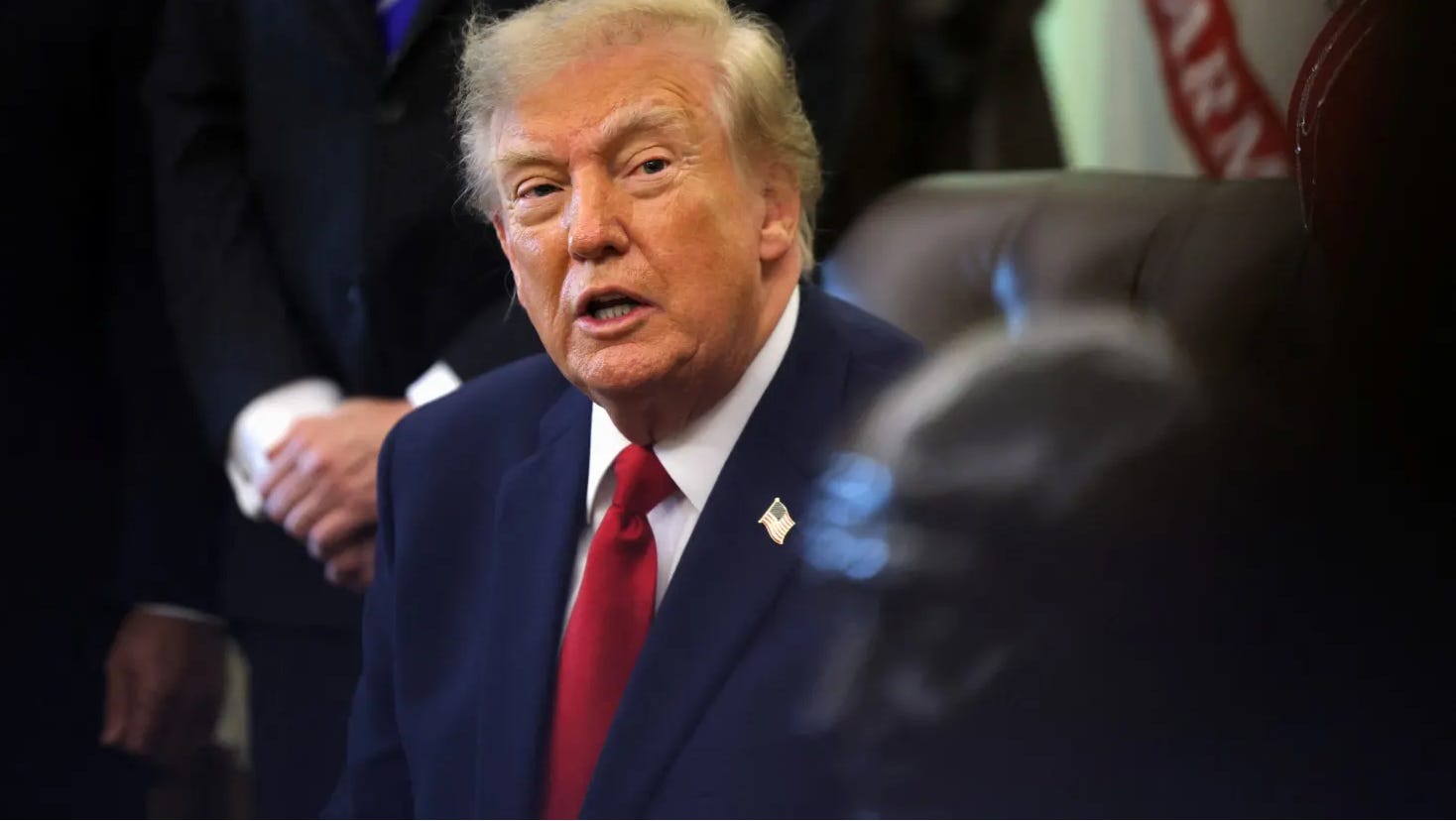
Scott: In August, Trump scored big stakes in Meta and SpaceX, in each case affecting his trades shortly before announcing major US Government decisions that were certain to appreciate the value of the equities (or debt securities) involved. The facts as set out in CNBC’s report would appear to be sufficient to open investigations predicated on felony violations of the STOCK Act of 2012 as well as Rule 10b-5 of the Securities and Exchange Commission, and other federal and state statutes. Moreover, as these are not official acts, the immunity from investigation and prosecution conferred on Trump by the Roberts Court is not available. Count on it that Trump’s DOJ and SEC will neither investigate nor act on these crimes.
President Donald Trump disclosed more than 500 securities transactions in August, including a purchase of up to $25 million in Meta stock and an investment of as much as $5 million in SpaceX
debt two days before he signed a sweeping policy aimed at expanding U.S. commercial space transportation, according to a newly released financial disclosure.
The 517 purchases and sales totaled roughly $74.3 million to $273.3 million, according to a CNBC analysis of Trump’s August financial disclosure, which reports each item in a range of value. Purchases accounted for at least $44.2 million and sales at least $30.1 million, CNBC calculated.
The 18-page filing shows Trump’s portfolio remained highly active, even as trading slowed from June and July, when he disclosed more than 1,000 transactions in each month.
The largest transaction was an Aug. 21 purchase of between $5 million and $25 million in Meta shares, amid a broader portfolio reshuffling that day. Trump also reported buying between $1 million and $5 million each of AT&T, ConocoPhillips, Abbott Laboratories, Netflix and Chevron the same day.
Trump declares anyone who uses the term Artificial Intelligence to be ‘The Enemy!’
The Independent
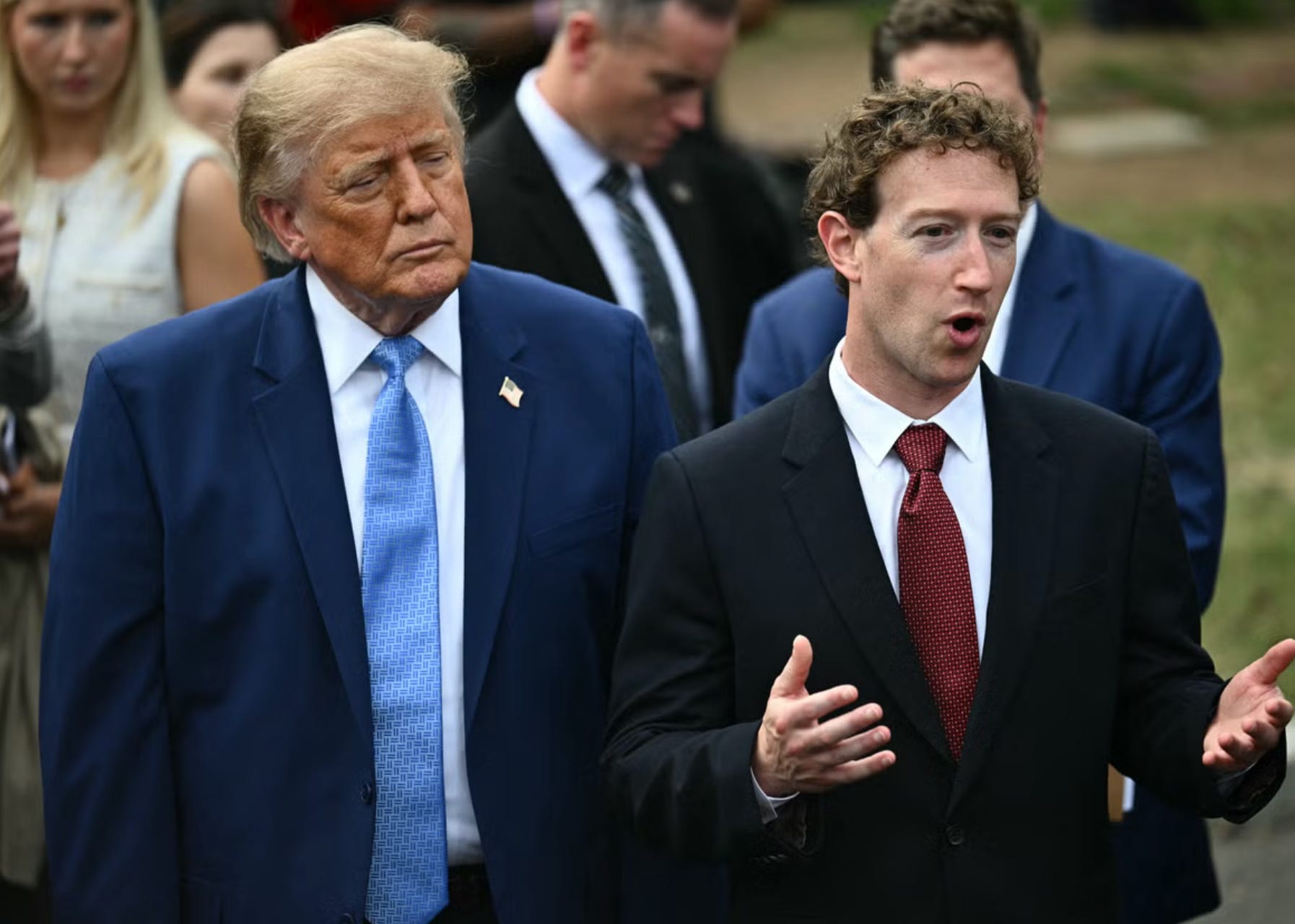
The Odd Couple: Mark Zuckerberg and Donald Trump are now best of friends, and Trump is a heavy Meta investor. A new exposé on Zuckerberg entitled Social Responsibility opens in the US and UK tomorrow.
Scott: Trump struck a simple bargain with the tech bros during the run-up to the 2024 elections—they would support him unconditionally and with loads of cash and media manipulation. And in exchange, he would unfetter them from regulation and reward them with tens or hundreds of billions in government contracts, while making their duty to pay taxes much more theoretical than ever before. At his AI summit, Trump came through once more for them—as the illiterate (and nonbinding) document it generated showed. Now what will they do for him, particularly with the midterms in view?
President Donald Trump on Thursday opened up a new front in his ongoing war against commonly used terms and geographic names by warning that anyone referring to Large Language Models such as OpenAI’s ChatGPT or Anthropic’s Claude as “Artificial Intelligence” would earn themselves a place on his enemies list.
Writing on Truth Social, he declared that the White House “considers anyone that uses the term, ‘Artificial Intelligence,’ as opposed to the highly accepted new and more accurate term, ‘Super Intelligence,’ THE ENEMY!”
The president’s outburst-cum-veiled threat landed just over a week after he signed an executive order directing executive branch agencies to begin referring to artificial intelligence, which is now embedded across the federal government, as “super intelligence” following a lunch with leaders in the AI industry, including Elon Musk, Sundar Pichai, Dario Amodei and others.
That widely mocked directive followed bizarre remarks to the U.N. General Assembly in which he declared that the U.S. “totally rejects any attempt to construct a globalist scheme” for regulating AI and declaring that the technology would be “hereinafter officially called super intelligence” because “use of the word artificial makes intelligence fake.”
“It makes it sound fake, and it is not fake. It’s actually amazing,” said Trump, who the week before had launched a poll in his Truth Social feed over the weekend asking respondents to vote for either “Super Intelligence,” “Superior Intelligence,” or “Extreme Intelligence.”
Trump’s Retreat: From the Gulf to Britain, American Forces Pull Back
New York Times
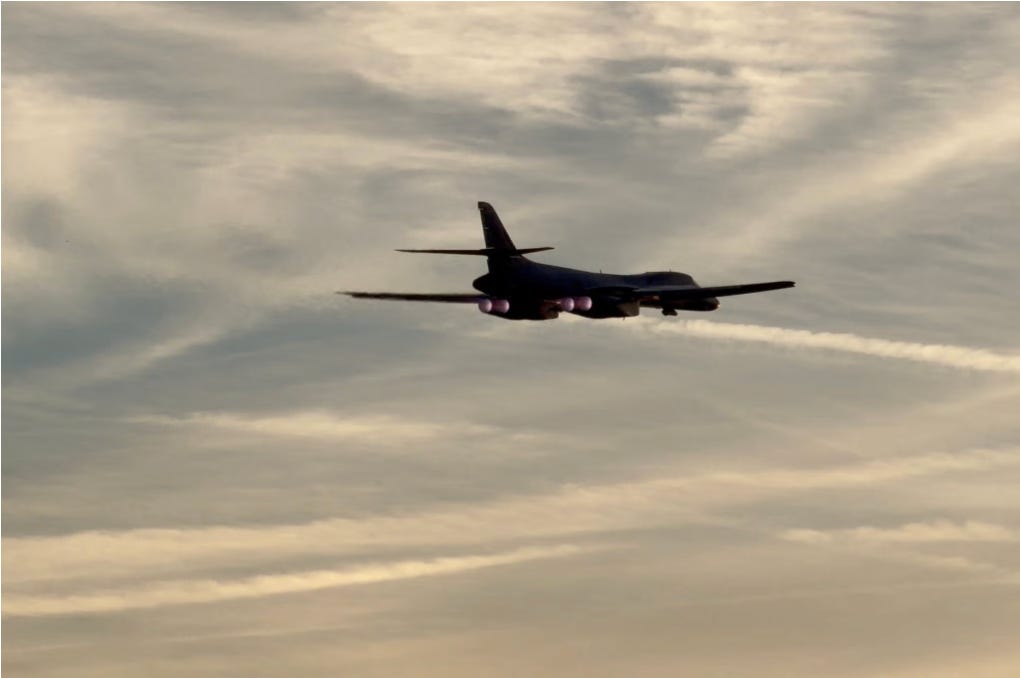
The RAF Fairford air base, from which a dozen American B-1 bombers were withdrawn last weekend, has been a mainstay of US-UK military cooperation since it opened in 1944. Photo: Craig Young/Reuters
Scott: In the midst of a war in which the US is projecting force into a battleground on the other side of the planet, the US has lost 18 military installations due to enemy attack—a fact Peter Hegseth appears to have decided that the Congress and White House don’t really need to know. He also withdrew B-1 bombers for reasons so absurd that they provoke laughter from military analysts when set out. What is all this about? On one level, it’s the most grotesquely incompetent military management America has seen since the Revolution. On another, it reflects the profound lack of seriousness that surrounds Trump’s warmaking, and his indifference to the safety and care of American service personnel—whom he derides as “suckers and losers.”
To hear President Trump and his aides describe it, the rush to withdraw 12 B-1 bombers from an air base in Britain over the weekend was a prudent precaution, in response to a threat they refused to describe.
It was no big deal, Mr. Trump insisted, and his secretary of state, Marco Rubio, tried to wave it away by noting that the Pentagon is “constantly reallocating resources where they need to be.”
But to anyone watching the deployment of American power around the globe in the seven months since Mr. Trump decided to attack Iran, it was another glaring example of how, time after time, Mr. Trump and his defense secretary, Pete Hegseth, have been forced into retreat, pulling back military forces that had been deployed to the Middle East and Britain as a deterrent.
Over the past several months, as the conflict has dragged on, the Iran war has come to reveal enormous new American vulnerabilities, forcing changes that the Pentagon was not contemplating a year ago. But it has also proved a bitter lesson in the unintended consequences that have flowed from Mr. Trump’s war of choice.
Mr. Trump intended the attack on Iran as another demonstration of the American military’s extraordinary power, following the successful bombing raid on three Iranian nuclear sites in June 2025 and the seizure of President Nicolás Maduro of Venezuela from his bed in Caracas in January.
But rather than enhance American power, the war has constrained it. The closing of bases in the Middle East and limiting the use of one in Britain have, at a minimum, vastly complicated the logistics of projecting power. American bombers can still reach their targets, of course, but only by flying from the United States, requiring more time and refueling. American carrier groups can still patrol in the Arabian Sea, outside the Persian Gulf, but now they must be resupplied from Diego Garcia, an island in the Indian Ocean 2,200 miles away, requiring additional weeks and huge costs.
But most importantly, the rapid withdrawals have taught a lesson to the Iranians — and potentially to other adversaries — that they hold the power to chase out a superpower. In Europe, Mr. Trump and Mr. Hegseth are thinking of reducing American forces on their terms and their schedule. In the Middle East and Britain, their hand was forced…
The subject of the bases is such a sore one for the Pentagon that it has refused to provide Congress with cost estimates to repair or rebuild the facilities, which lawmakers said could run tens of billions of dollars. It is unclear what is motivating the refusal to discuss the topic, though a price tag that big could become political fodder for candidates opposing the war.
Instead, there is now serious planning at Central Command, which oversees military operations in the Middle East, to reposition and reshape its facilities in the region.
“The financial costs have continued to climb by billions each month, even as the administration refuses to acknowledge the munitions crisis we face or admit the costs to rebuild bases heavily damaged by Iran,” Senator Jack Reed of Rhode Island, the ranking Democrat on the Armed Services Committee, said last month.
The Saturn System Smörgåsbord

Explanation: How was the Saturn system imaged so clearly? Astrophotographer Tom Williams captured such exquisite details due to one night of exceptional atmospheric conditions above the United Kingdom. This means more than a cloudless sky. Pockets of air at different temperatures and densities move around and bend light as it travels through Earth’s atmosphere, distorting astronomy images. This is called “seeing.” Less atmospheric turbulence means clearer images. The astrophotographer reduced the impact of seeing with the lucky imaging technique: thousands of short-exposure images are taken very quickly with a high-speed camera and the clearest images are added up. Which object in this smörgåsbord interests you? Perhaps Titan or the icy stripes of Enceladus? Maybe the gaps and spokes in Saturn’s rings? Saturn’s opposition, when Earth passes in between the planet and the Sun, occurred on October 4th. Due to the planet’s proximity and full illumination from the Sun, now is a great time of year to observe it!
Your Online Moment of Zen
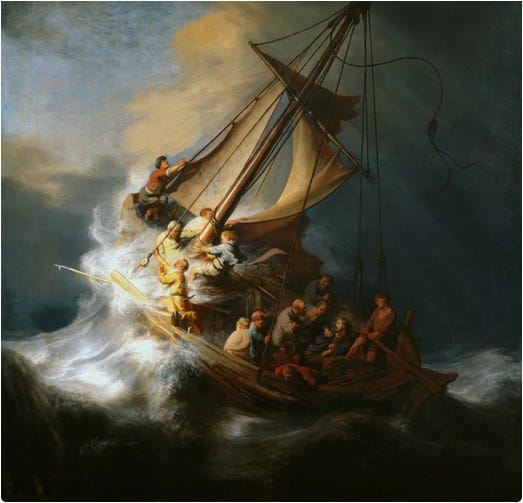
Storm on the Sea of Galilee
Rembrandt
1633
Isabella Stewart Gardner Museum Boston
Another great installment!